
CUDA is a tool made by NVIDIA that lets developers use the GPU for heavy tasks like data processing and graphics. It simplifies GPU programming by providing easy libraries and parallel computing features. This means faster performance, less coding effort, and better control compared to traditional CPU-based programming methods.
This is why it is widely used in gaming, AI, and data processing. In this guide, you will learn how CUDA works and why it is important today.
What is CUDA and why is it Important?
CUDA (Compute Unified Device Architecture) is a powerful NVIDIA technology that uses GPU computing to run heavy tasks faster. It is important because it boosts performance in gaming, video editing, and AI tasks. CUDA helps software use GPU power instead of CPU, making processing speed faster, smoother, and more efficient.
How Does CUDA Work in GPU Programming?
CUDA works by using NVIDIA CUDA technology to divide large compute tasks into smaller parts and run them at the same time using parallel processing. It uses thousands of CUDA cores, based on GPU architecture basics, to deliver strong GPU acceleration and high processing speed.
This high-performance computing method is much faster than GPU vs CPU computing, and developers use the CUDA toolkit to build and manage these programs efficiently.
How CUDA Makes GPU Programming Easier:
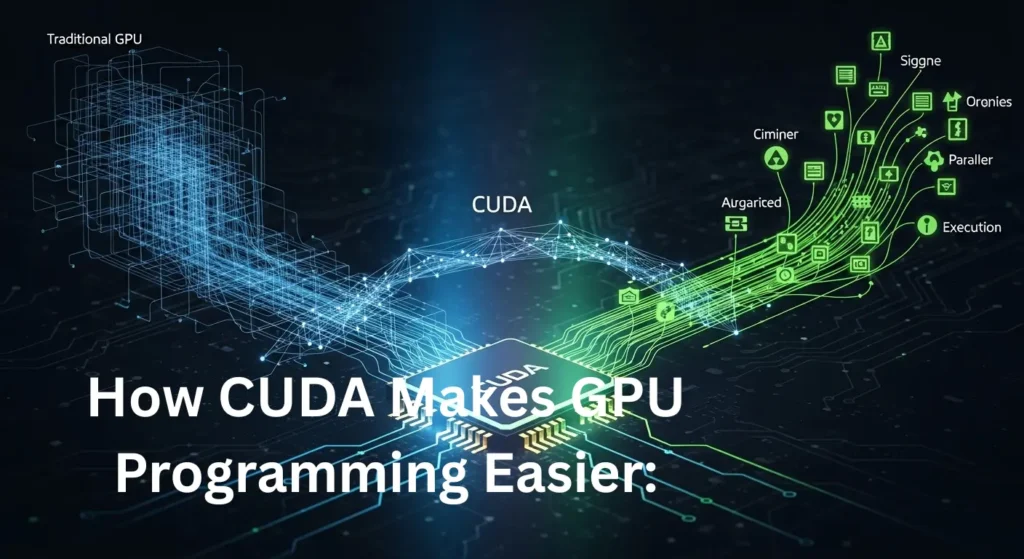
How CUDA Makes GPU Programming Easier is by simplifying complex GPU work into easy code using the CUDA toolkit. It supports large data handling, real-time processing, hardware acceleration, thread execution, and smart memory management in GPU systems. It also helps developers understand GPU architecture basics and improve performance in NVIDIA GPU technology.
CUDA vs OpenCL shows CUDA is more developer-friendly, especially for deep learning with CUDA and AI and machine learning GPU tasks, making programming faster, scalable, and more efficient.
Key Benefits of Using CUDA for Developers:
Key Benefits of Using CUDA for Developers include faster processing, better performance, and efficient use of GPU power.
Also Read: How To Increase GPU Wattage In Elden Ring?
Key Benefits of Using CUDA for Developers:
- Faster Performance: CUDA uses GPU power to run heavy tasks much faster than a CPU alone.
- Better Speed for Apps: It improves speed in AI, gaming, and data processing projects.
- Efficient Parallel Processing: Many tasks run at the same time, saving development time.
- Optimized GPU Usage: Helps developers fully use the graphics card’s power.
- Scalable Development: Works well for small to large-scale applications.
- Improved Productivity: Less waiting time means faster coding and testing cycles.
- Supports Advanced Computing: Ideal for AI, deep learning, and 3D graphics tasks.
CUDA vs Traditional CPU Programming:
CUDA vs Traditional CPU Programming shows a clear difference. CUDA uses GPU parallel processing to handle large data faster in AI, graphics, and simulations. Traditional CPU programming works in serial processing, handling tasks step by step. CUDA gives high-speed performance, while CPUs provide flexible and stable general-purpose computing for systems.
Why Programmers Use CUDA for Faster Computing:
CUDA is used by programmers because it allows the GPU (Graphics Processing Unit) to handle heavy tasks much faster than a normal CPU. It improves speed, performance, and efficiency in modern computing.
- Faster Processing: CUDA uses many GPU cores at the same time, making the work much quicker.
- Better for AI & Machine Learning: It handles large data training easily.
- High Performance in Graphics: Games and 3D apps run smoother.
- Parallel Computing Power: Many tasks run together, not one by one.
- Saves Time: Complex calculations finish in less time.
| Feature | CPU (Normal Processing) | CUDA GPU (Parallel Processing) |
| Speed | Slower for heavy tasks | Very fast for large tasks |
| Task Handling | One by one | Many at the same time |
| Best Use | Everyday work | AI, gaming, deep learning |
| Efficiency | Limited cores | Thousands of cores |
Programmers prefer CUDA because it makes modern computing powerful, fast, and scalable for real-world demanding applications.
How CUDA Helps in Parallel Processing:
CUDA helps in parallel processing by using NVIDIA GPU technology to split compute tasks into many threads for fast execution. It improves GPU acceleration, processing speed, and real-time processing for large data handling. Compared to CUDA vs OpenCL, it gives better hardware acceleration, high-performance computing, and efficient memory management in GPU systems.
Also Read: Why Is My GPU Usage at 100% All the Time?
Is CUDA Beginner-Friendly for GPU Programming?

Yes, CUDA is beginner-friendly for GPU programming when you start with simple CUDA programming basics. It helps users understand GPU acceleration and parallel processing easily. Beginners can slowly learn how to use CUDA for GPU acceleration, improving processing speed, compute tasks, and real-time processing with practice.
It is mainly built on NVIDIA GPU technology and supports high-performance computing through hardware acceleration. At first, CUDA vs OpenCL or GPU architecture basics may feel complex, but step-by-step learning makes it simple. With time, users also understand memory management in the GPU and the CUDA toolkit used for large data handling and better thread execution.
Tips to Make CUDA Programming Easier:
- Start with basic GPU and CUDA concepts to build a strong understanding
- Write small CUDA programs first, then slowly increase complexity
- Learn CUDA memory types for better performance and fewer errors
- Use tools like NVIDIA Nsight for easy debugging and optimization
- Keep code simple and practice regularly for real skill improvement
Difference Between CUDA and OpenCL:
- CUDA (Compute Unified Device Architecture):
CUDA (Compute Unified Device Architecture) is a powerful programming platform developed by NVIDIA. It is designed to leverage the full power of NVIDIA GPUs for heavy computing tasks such as gaming performance, AI processing, deep learning, and video rendering. CUDA is highly optimized, fast, and gives excellent performance, but it only works with NVIDIA graphics cards, not with AMD or Intel.
- OpenCL (Open Computing Language):
OpenCL (Open Computing Language) is an open standard framework that runs across different hardware platforms, including AMD, Intel, NVIDIA, and even mobile GPUs. It is flexible and supports cross-platform computing, making it useful for developers who want wider compatibility. However, OpenCL is usually less optimized and can be slower compared to CUDA in high-performance tasks.
Do CUDA and OpenCL Work the Same Way?
CUDA and OpenCL do not work in the same way. They both are used for GPU programming, but have different designs and structures. CUDA is NVIDIA-only and easier for optimized performance, while OpenCL works on many devices and is more flexible for cross-platform support in real-world development use cases today.
Unlocking the Power of CUDA Programming:
Unlocking the Power of CUDA Programming means learning how NVIDIA CUDA helps developers boost GPU performance for faster computing. It improves speed in AI, graphics, and data tasks by using parallel processing. This powerful technology makes complex workloads easier, faster, and more efficient for real-world software development and innovation.
Also Read: Is CAD Software CPU or GPU-intensive?
Conclusion:
CUDA is a powerful NVIDIA technology that makes GPU programming faster and more efficient. It improves performance in AI, gaming, and data processing by using parallel computing and GPU acceleration. Developers use CUDA to simplify complex tasks and achieve high-speed computing compared to traditional CPU methods. It is widely used for modern applications and future technology development around the world.
FAQ’s:
1. Is CUDA only used for gaming GPU performance?
No, CUDA is not only used for gaming. CUDA (Compute Unified Device Architecture) is widely used in many fields like artificial intelligence, machine learning, scientific simulations, and data processing. It helps developers run complex calculations faster using the GPU, not just improve gaming graphics.
2. Does CUDA simplify GPU programming for beginners?
Yes, CUDA simplifies GPU programming by providing easy tools, libraries, and parallel computing support. Instead of writing very complex GPU code, developers can use CUDA’s structured environment to handle heavy tasks more easily and efficiently.
3. Can CUDA improve the speed of AI and machine learning tasks?
Yes, CUDA significantly improves the speed of AI and machine learning tasks. It allows GPUs to process many calculations at the same time, which makes training models faster and more efficient compared to CPU-based processing.
4. How does CUDA make GPU programming easier compared to traditional methods?
CUDA makes GPU programming easier by offering a high-level programming model, reusable libraries, and parallel execution features. This reduces the need for complex low-level GPU code and helps developers focus more on logic and performance.
5. What are the main benefits of using CUDA in modern computing applications?
CUDA provides faster processing, better performance, and efficient parallel computing. It is widely used in AI, data science, engineering, and research because it helps handle large and complex workloads in less time.